
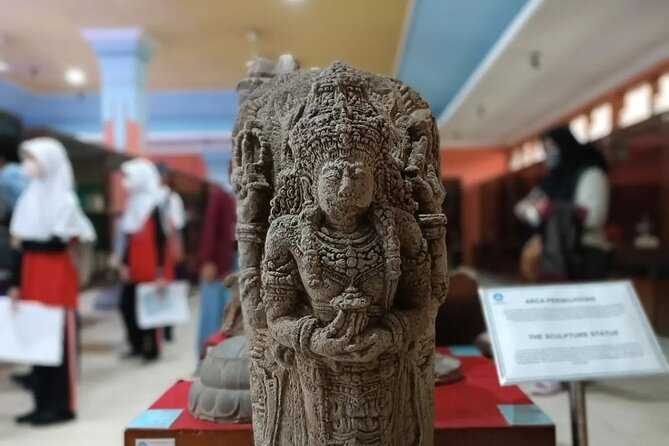
Reviewed · HISTORICAL TOURS
Half-Day Private Majapahit Historical Tour from Surabaya
Majapahit’s old capital area is a fine reminder that Java’s past is not locked away in a museum. You’ll walk among red-brick gates and temples at Trowulan, where ruins still hint at the reach of an empire that shaped culture in Java and Bali. I especially like the private format and the mix of famous sites with quieter ruins such as Kedaton Temple.
The tour also earns points for its air-conditioned vehicle, bottled water, and included admission fees. Guides such as Ryan and Dea can add humor and clear English to the history, and the driver can adjust the day when traffic or your interests call for it. The main catch is time: five hours goes quickly, and the sites have limited English signage, so you’ll get more from the visit if you ask questions.
Key points at a glance
- Five Majapahit sites in about five hours: Visit Wringinlawang, Brahu, Bajang Ratu, Tikus, and Kedaton Temple.
- Private transport from Surabaya: Only your group takes part, with pickup offered and an air-conditioned vehicle.
- Red-brick architecture: See gates and temples that influenced building styles in Bali and other parts of Indonesia.
- Guides who bring the story to life: Ryan is praised for excellent English, humor, and detailed explanations, while Dea has also guided the tour.
- Good value for a private outing: At $79.39 per person, the price includes fuel, parking, bottled water, transport, and admission.
- A tight schedule: Each main stop receives about 30 minutes, while Kedaton Temple gets 90 minutes.
Why Majapahit matters in Java
Majapahit was one of the major empires in Indonesian history. Its influence reached well beyond the brick ruins around Trowulan, shaping ideas of power, religion, architecture, and culture in Java and Bali.
The remains here do not look like a single grand palace complex waiting intact for visitors. Instead, you see fragments: gateways, temple foundations, bathing structures, and scattered ruins. That is part of the appeal. You have to look closely and listen to the guide to understand how these pieces once related to a larger royal center.
I like this approach because it gives you more than a quick photo stop. The tour asks you to think about how historians read old brickwork, temple shapes, religious symbols, and surviving scripts. Some later kingdoms even used the Majapahit name to support their own authority, a sign of how powerful its memory remained.
For you, the important point is simple: this is not just a temple tour. It is a short introduction to the political and cultural world behind several of Indonesia’s most recognizable architectural traditions.
More Historical Tours in Surabaya & Malang:
- Majapahit Heritage Archaelogy tour via surabaya
★ 4.5 · 16 reviews - Crafting Heritage Batik Painting Workshops
★ 5.0 · 164 reviews - Jakarta Heritage of Old Batavia Private City Tour (Historical)
★ 5.0 · 143 reviews
Leaving Surabaya for Trowulan
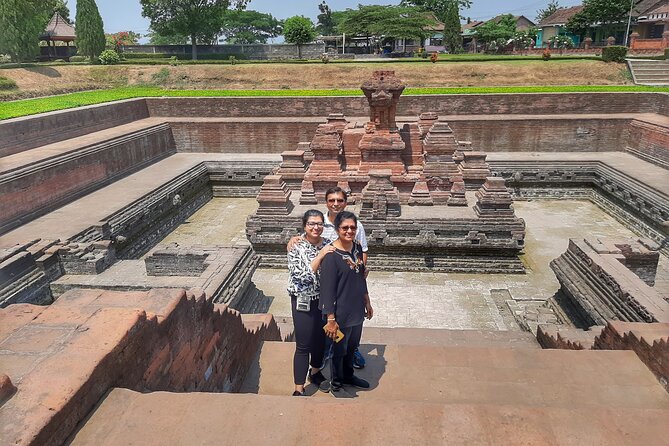
The tour lasts about five hours and includes pickup from Surabaya. You ride in a private, air-conditioned vehicle, with fuel, parking fees, bottled water, and entrance tickets covered in the price. Lunch is not included, so plan around that if you are hungry after the final stop.
The private format matters here. You are not waiting for a large group to finish photographs or follow a fixed pace. The guide can respond to questions, spend more time at a site that interests you, or adjust the day when road conditions change.
Traffic can be a real factor around Surabaya. One account of the tour describes the driver taking a smaller alternate route to avoid a jam caused by a broken-down lorry. You should not expect every road delay to disappear, but an experienced local driver is useful when the schedule is compact.
About 30 minutes of the listed route involves the Mojokerto to Surabaya toll road. That drive is not a sightseeing stop, but it is part of the practical connection between the city and the Trowulan area. The countryside helps break up the urban traffic, and the private car keeps the transfer comfortable.
The tour is often booked well ahead, with an average booking time of 61 days. That does not mean you must reserve that far in advance, but it is a useful sign for anyone building a cruise stop or a short Surabaya visit around a particular date.
Wringinlawang, the tall brick gateway
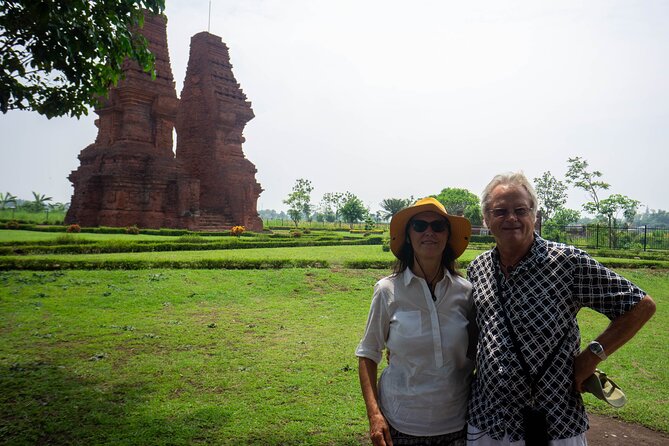
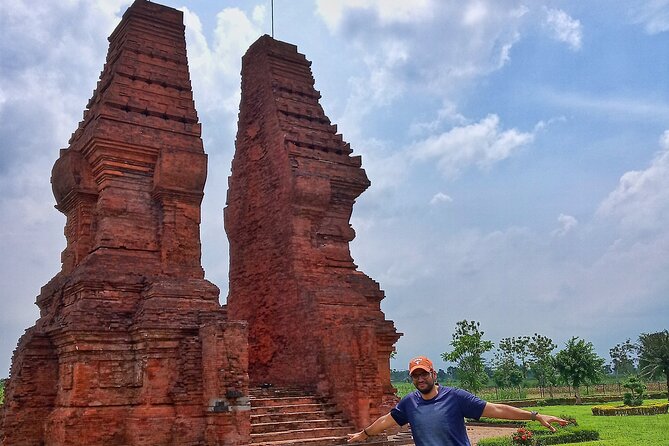
Your first main stop is Candi Wringinlawang, a pair of imposing red-brick gates rising about 50 feet. The structure dates from the 14th or 15th century and is generally understood as a gateway rather than a temple.
That distinction makes the stop more interesting. Instead of looking for a shrine interior, you study the form of the entrance and consider what kind of important space might once have stood beyond it. The gate gives you an early lesson in how Majapahit architecture used brick on a large scale.
You have about 30 minutes here, with admission included. That is enough to walk around, see the proportions of the structure, and hear the basic explanation from your guide. It is not enough for a long archaeological discussion, so ask questions early if you want more detail.
The site is also a good place to notice how much the experience depends on interpretation. Without an English sign or a guide, you may understand that the gateway is old, but not why its shape matters. Ryan, in particular, is praised for clear English, humor, and detailed explanations of the historical setting.
Candi Brahu and the sacred side of Majapahit
Candi Brahu is another red-brick structure, but its story has a more religious tone. It was once believed to have served as a crematorium for a deceased king, and the temple was built before the Majapahit period itself.
That earlier date gives the stop useful context. Majapahit did not appear in a vacuum. Older buildings, beliefs, and local traditions were already part of the area, and the empire inherited and reshaped them.
The temple is described as a sacred place that remains in use for religious purposes. You may find this more meaningful than a ruin that exists only as an archaeological object. Treat the site with care, follow your guide’s directions, and remember that the brickwork is part of a living cultural setting as well as an ancient one.
Again, the planned visit is about 30 minutes. The grounds are described as clean and well tended, which helps you focus on the structure rather than on maintenance issues. The lack of English signs can be frustrating, but a guide with strong English can fill in the missing background.
A few more things to do around Surabaya & Malang
- Half Day – Malang Batik Class
★ 5.0 · 8 reviews - Half Day Bali Tour
★ 5.0 · 556 reviews - Half-Day Ubud Electric Cycling Tour to Tirta Empul Water Temple
★ 5.0 · 315 reviews - Jakarta Half-Day Guided Tour with a Private Fun Local Host
★ 5.0 · 292 reviews
Bajang Ratu and the gateway to sacred space
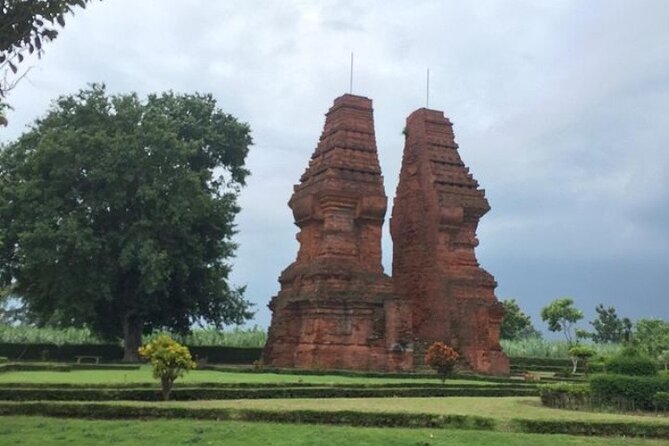
Candi Bajang Ratu shares an important feature with Wringinlawang: its form suggests a gateway leading toward something sacred rather than a conventional temple building.
This is a useful place to compare two structures side by side in your mind. You begin to see that Majapahit architecture was not a single repeated design. Gateways could mark changes in status and movement, guiding people from ordinary space toward an important religious or royal area.
The site also offers a link to Bali. Its architectural influence can be seen in later Balinese forms, making this more than an isolated ruin in East Java. If Bali is part of your wider Indonesia trip, this stop adds background to the gateways and temple entrances you may see there.
You receive about 30 minutes at Bajang Ratu. That is sufficient for a guided walk and photographs, though the schedule leaves little room for a slow, independent study. I would keep your camera ready but listen first. The value of this stop lies in the explanation of what the shape means.
Candi Tikus, a royal bathing place
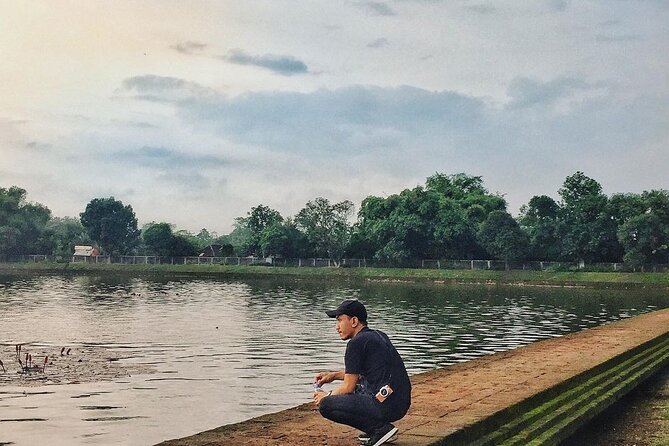
Candi Tikus has one of the more memorable names on the route. It was called Tikus, meaning rat, because of conditions found during its excavation. The structure itself is believed to have been a bathing site for the royal family.
This was not simply a place for washing. The bathing area could be used before a ritual or for pleasure, linking daily royal life with religious practice. That gives the site a more personal feel than a monument tied only to kings and ceremonies.
At Candi Tikus, you can look at the arrangement of the remains and imagine how water and movement shaped the space. The guide’s explanation is especially useful here, since the ruins may not immediately tell you whether you are looking at a temple, a pool, or part of a palace complex.
The stop lasts around 30 minutes. It is worth keeping your expectations realistic: you are seeing archaeological remains, not a restored royal bath. Still, the function of the place makes it one of the easiest sites to remember after the tour.
Kedaton Temple and the largest block of time
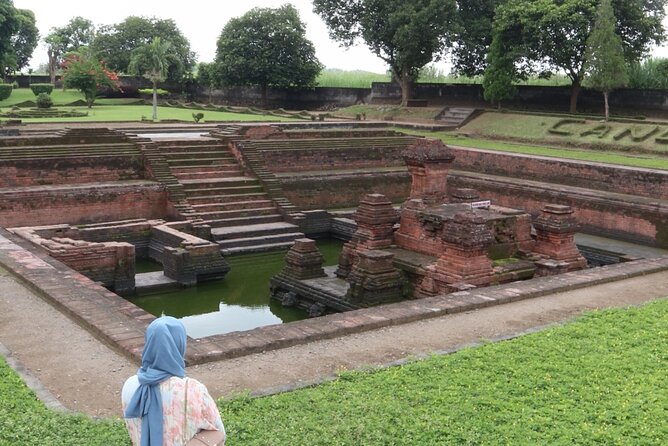
Kedaton Temple receives about 90 minutes, the longest visit on the route. The ruins are believed to have formed part of the palace complex, so this is where the separate pieces of the morning or afternoon begin to connect.
You may find less immediately recognizable architecture here than at the tall gateways. That can be a drawback if you want one dramatic structure after another. It can also be the most rewarding stop if you enjoy fitting fragments together and asking how a royal center might have been organized.
Use the extra time to ask about the relationship between palace life, sacred buildings, gates, and bathing areas. A good guide can help you understand why archaeologists connect scattered remains with a former capital rather than treating each structure as an isolated monument.
The longer stop also gives you a little breathing room. The first four sites each have a 30-minute limit, while Kedaton lets you slow down. If one of the earlier temples feels rushed, you can raise your questions here while the overall story is still fresh.
Guides, language, and the value of a private format
Guide quality matters on a historical tour with limited English signage. Ryan receives especially strong praise for his English, humor, detailed site explanations, and careful driving. Dea is also named as a guide who brings enthusiasm for local culture and history.
You should still take an active role. One account found that the guide offered more information when prompted, while another noted that two guides did not have the same level of English or historical detail. That is a fair reminder that the experience can vary by the guide assigned to your date.
The private format gives you a simple advantage: ask questions as soon as something catches your attention. Ask why a building is called a gate, how the ruins relate to Bali, or what evidence links a site to royal use. You are paying for access to interpretation, not just a vehicle between monuments.
The tour is suitable for most people, and pickup is offered. A private vehicle can also help if someone in your group needs a more flexible pace. Still, specific accessibility features are not provided, so you should confirm any mobility requirements before booking.
Is $79.39 per person good value?
At $79.39 per person, the tour is not the cheapest way to see old buildings near Surabaya. It is priced as a private experience, not a basic shared transfer.
The cost includes:
- Private transportation
- Air-conditioned vehicle
- Fuel surcharge
- Bottled water
- Parking fees
- Admission to the listed sites
Lunch is extra. The value improves when you are sharing the vehicle with several people, and group discounts may be available. For a couple or small group, the price buys convenience, a five-hour schedule, and a guide who can explain what you are seeing instead of leaving you to guess.
I would compare it with the cost and effort of arranging several local transfers on your own. The tour reduces that work and keeps the day focused on Majapahit sites. If your main goal is simply to photograph one temple, it may feel expensive. If you want the historical connections explained, the private format makes more sense.
Who should book this half-day tour?
I would recommend it to you if you are staying in Surabaya, arriving by cruise, or want an efficient introduction to East Java’s ancient past. It suits people who prefer a private car, clear scheduling, and a guide who can adjust the pace.
It is also a good choice if Bali is part of your wider trip. The discussion of architectural influence helps connect what you see in Java with temple forms elsewhere in Indonesia.
You may want a different plan if you dislike ruins, need a full meal included, or want long, unstructured time at each site. Five hours is enough for a useful introduction, but not enough for an exhaustive archaeological study. The limited English signage also means the experience depends heavily on asking questions and getting a strong guide.
Free cancellation is available until 24 hours before the start time. After that cutoff, the amount paid is not refunded, and late changes are not accepted.
Should you book it?
Book this tour if you want the Majapahit story explained through real places rather than a short museum visit. The route gives you variety: towering gateways, a sacred brick temple, a royal bathing site, and palace ruins. The air-conditioned private vehicle and included entrance fees make the day easy to manage from Surabaya.
I would book it especially for a small group that values history and personal guiding. Ask for a guide with strong English if that is important to you, and remember to budget for lunch. If you want a relaxed, practical look at one of Indonesia’s most influential ancient empires, this is a solid use of half a day.
FAQ
How long does the Majapahit tour last?
The tour lasts approximately five hours.
Where does the tour operate?
The experience begins in Surabaya and visits the Majapahit archaeological sites around Trowulan and Mojokerto.
Is hotel or location pickup offered?
Pickup is offered. The tour also includes private transportation in an air-conditioned vehicle.
Which historic sites are included?
The route includes Candi Wringinlawang, Candi Brahu, Candi Bajang Ratu, Candi Tikus, and Kedaton Temple. It also includes travel on the Mojokerto to Surabaya toll road.
Are entrance fees included?
Yes. Admission tickets for the listed stops are included, along with parking fees, fuel surcharge, bottled water, and private transport.
Is lunch included?
No. Lunch is not included in the tour price.
Can I cancel for a full refund?
Yes, if you cancel at least 24 hours before the experience start time. Cancellations made less than 24 hours before the start time are not refunded.
Just added around Surabaya & Malang
- 1 Day – Malang Beaches and Island Hopping // 06:30 – 17:30★ 5.0 · 7 reviews
- Private Airport Transfer Surabaya★ 5.0 · 6 reviews
- Trowulan Tour Ruin of Majapahit Kingdom from Surabaya★ 5.0 · 25 reviews
- Surabaya Shore Excursion For Cruise Passengers★ 4.5 · 52 reviews
- Half Day – Malang Batik Class★ 5.0 · 8 reviews
- Majapahit Heritage Archaelogy tour via surabaya★ 4.5 · 16 reviews
- Private Day Tour Surabaya Historiculture★ 4.5 · 84 reviews
- Surabaya Private Tour★ 5.0 · 86 reviews
Historical Tours, compared.
Jakarta Heritage of Old Batavia Private City Tour (Historical)
Read our review →
Bali Unesco World Heritage Sites Tour (Private & All-Inclusive)
Read our review →Ulun Danu Beratan Temple – Tanah Lot Temple Tour by UNESCO World Heritage
Read our review →
Yogyakarta Cultural Tour: Borobudur Temple, Prambanan Temple and Merapi Volcano
Read our review →
Bali ATV Kuber Through Historic Tunnel and Scenic Waterfalls
Read our review →Browse the lists this tour appears in