
Reviewed · SURABAYA & MALANG
Private Day Tour Surabaya Historiculture
Surabaya’s story is best read in layers: a submarine from Indonesia’s naval past, Dutch-era public spaces, Chinese shops and temples, an Arab quarter around a major mosque, and markets where daily trade still matters. This private tour connects those pieces in four to five hours, with a driver and guide moving you between districts and letting you walk where the streets tell the fuller story.
I like the private format, especially if you are arriving by cruise ship and need to watch the clock. I also like the mix of monuments and ordinary neighborhoods. The markets and old quarters give you more than a string of photo stops. The main caution is that guide quality can vary. Several guides, including Elvira, Rina, Ryan, and Nabiilah, have been praised for clear English and strong local insight, but some guests found the historical explanations too thin.
Key points to know before booking
- A real submarine museum opens the tour: Monkasel is a walk-through naval monument, not just a statue.
- Three cultural quarters share the route: You pass through Chinese, Arabian, and European-era parts of Surabaya.
- Cruise-port pickup is a major advantage: Private transport helps you make the most of a short shore visit.
- Markets provide the most local flavor: Pabean and Ampel show trade, food, worship, and street life in motion.
- The pace can be adjusted: Guides such as Pram and Andri have worked around limited port time and guest preferences.
- The final stop is a shopping hour: Mirota Batik is useful for gifts, but it may feel less essential than the markets.
Why this private Surabaya tour works well
At $66.01 per person, the price makes the most sense when two or more people share the private vehicle and guide. You get transportation, fuel, parking, bottled water, entrance fees, and a private English-speaking guide, so you are not piecing together taxis and admissions on your own.
The value is strongest for cruise passengers. Surabaya traffic can make a short visit feel shorter, and a driver who knows the route can keep the day moving. Andri was praised for explaining the submarine’s background while also helping a guest judge how much time remained before returning to the ship. That kind of time awareness matters more than squeezing in one extra monument.
You should expect a mix of driving and walking. The tour is not a long hike, but several stops involve strolling through markets, quarters, or public spaces. Most people can take part, and the activity is near public transportation, though the private pickup means you do not need to navigate the local system during the tour.
Guide assignments change. Names connected with especially strong experiences include Elvira, Ellen, Rina, Ins, Ryan, Nabiilah, Zidney, Pram, and Andri. You cannot request the same level of historical detail from every guide, so it is sensible to explain your interests when you book or when the guide contacts you on WhatsApp.
A few more things to do around Surabaya & Malang
- Surabaya Private Tour
★ 5.0 · 86 reviews - Surabaya Shore Excursion For Cruise Passengers
★ 4.5 · 52 reviews - Half-Day Private Majapahit Historical Tour from Surabaya
★ 5.0 · 38 reviews
Monkasel, the submarine you can walk through
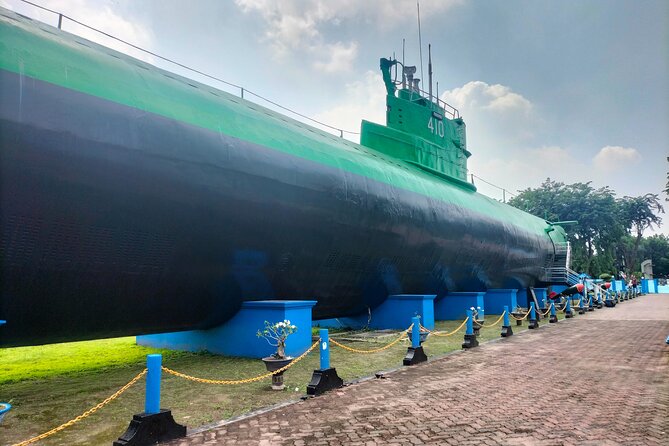
Monkasel, short for Monumen Kapal Selam, is the most distinctive opening stop. The attraction uses a real submarine, presented as the largest submarine monument in Asia according to the tour description. You enter the vessel rather than simply viewing it from a distance.
Allow about 30 minutes. Inside, the confined passageways and equipment give you a feel for how sailors worked in a very tight space. The visit is compact, making it a good first stop on a port day. It is also the place where a guide can add the most useful context, explaining the submarine’s role and why it has become part of Surabaya’s public identity.
The quality of this stop depends partly on the explanation. Andri received particular praise for making the submarine visit informative, and several guides have been described as prepared and easy to understand. If your guide moves quickly, ask about the vessel, its service, and its place in Surabaya’s history. You will get more from the visit than a few interior photographs.
Balai Pemuda and Surabaya’s public center
The tour continues to Balai Pemuda, a former Dutch community public place near Surabaya City Square. You spend about 30 minutes walking around the complex, which now includes an underground city square used as a museum and library center.
This stop helps explain the city’s European-era layer. It is less dramatic than the submarine, but it gives you a look at how an older civic space has been reused. The contrast between colonial public architecture and present-day civic functions is worth noticing.
Do not expect a large museum visit here based on the stated schedule. The stop is short, and the main value is seeing the setting and hearing how the place fits into Surabaya’s past. If your guide has good local background, this is a natural point to ask about Dutch influence, the city center, and the transition from colonial rule to Indonesian administration.
Chinatown, where the route turns toward daily life
The tour passes through Surabaya’s Chinese quarter, described as a central area filled with Chinese markets, street food, and temples. The route does not list a fixed admission stop here, so think of it as a moving introduction to the district rather than a formal museum visit.
This is one of the better parts of the tour for seeing how Surabaya’s communities share the city. Shops, food stalls, and religious buildings make the quarter feel lived in. You may have time to look around, but the exact amount depends on traffic and how long you spend at earlier stops.
I would ask your guide to point out what makes the Chinese quarter distinct rather than simply driving through it. Zidney was praised for explaining how different cultural groups live together, and that is the kind of conversation that can turn a pass through the district into a useful part of the day.
A completely different kind of day out in Surabaya & Malang:
- Trowulan Tour Ruin of Majapahit Kingdom from Surabaya
★ 5.0 · 25 reviews - Majapahit Heritage Archaelogy tour via surabaya
★ 4.5 · 16 reviews - Half Day – Malang Batik Class
★ 5.0 · 8 reviews - 1 Day – Malang Beaches and Island Hopping // 06:30 – 17:30
★ 5.0 · 7 reviews
Sunan Ampel Mosque and the Arabian quarter
At Sunan Ampel Great Mosque, you walk through Ampel Arabian Market for about 30 minutes. The mosque itself is free to enter, while the surrounding market gives the visit its strongest sense of place.
This district is tied to Surabaya’s Arab community and Muslim life. You will see shops and food sellers around the mosque, with the market streets offering a more immediate view of the neighborhood than a quick stop at a monument would provide. Dress respectfully, particularly because the route includes a mosque and a religious district.
This is a walking stop, so comfortable shoes help. The market can also be a good place to ask about local food, religious traditions, and the district’s connection to Surabaya’s cultural mix. Elvira was especially well regarded for answering questions through Chinatown, Pabean Market, and the Arabian Market, with English strong enough for detailed conversation.
The half-hour schedule is enough to get a feel for the area, but not enough for a slow market exploration. If this quarter interests you most, tell the guide early. A private tour gives you more room to set priorities than a fixed group excursion.
Pabean Market and the working side of Surabaya
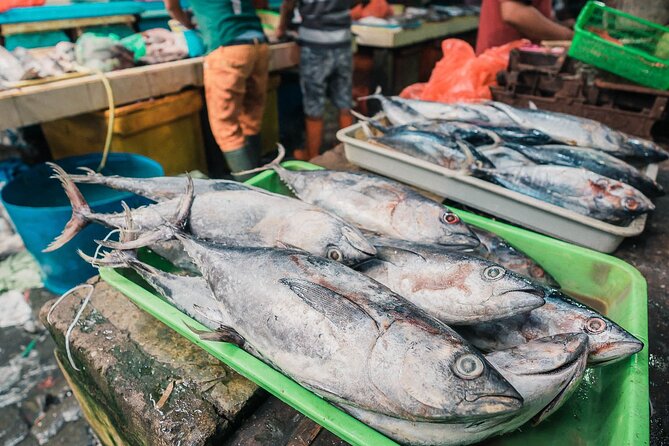
Pabean Market is a traditional fish market, with about 20 minutes set aside for walking through it. You see fresh fish brought together for sale and get a look at a part of the city built around work rather than display.
This may be the most authentic stop for people who want ordinary Surabaya rather than polished sightseeing. Markets can be crowded, wet, and strongly scented, so this is not a tidy attraction designed for visitors. That is exactly why it can be memorable, but you should be ready for a rougher setting than the public squares and monuments.
The short visit means you will not study every stall. Instead, use the time to watch how goods move, notice what is being sold, and ask the guide what role the market plays for local families and traders. The market also links naturally with the Chinese and Arabian quarters, showing how commerce ties these communities together.
Tugu Pahlawan and the Battle of Surabaya
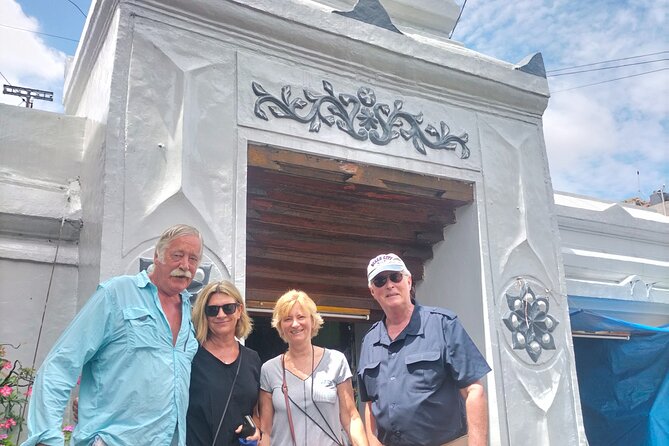
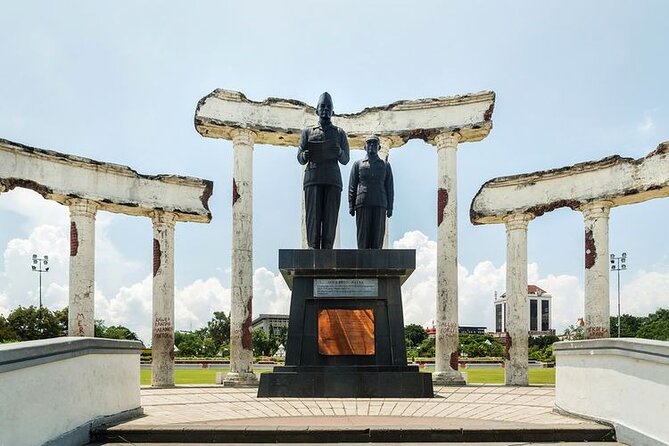
Tugu Pahlawan, or Heroes Monument, is the main stop for understanding why Surabaya is called the City of Heroes. You spend about 30 minutes at the monument, which recalls the Battle of Surabaya and the city’s role in Indonesia’s struggle for independence.
This is not simply a large structure for photographs. It is the point where the day’s cultural tour connects with national history. A good guide should explain what the battle meant and why the memory remains important in Surabaya.
The historical background is essential here. Some guests found that guides explained the listed sites well but offered little beyond them, so ask direct questions if you want more context. Ryan, Rina, Nabiilah, and Zidney were praised for giving clearer explanations of Surabaya’s past and culture. Your experience may depend on who is assigned.
If you have a strong interest in modern Indonesian history, this stop may feel brief. Still, it gives the tour a useful center of gravity after the markets and neighborhoods. The city’s identity is not only about ethnic quarters and old buildings. It is also about resistance and national pride.
Mirota Batik for souvenirs and local design
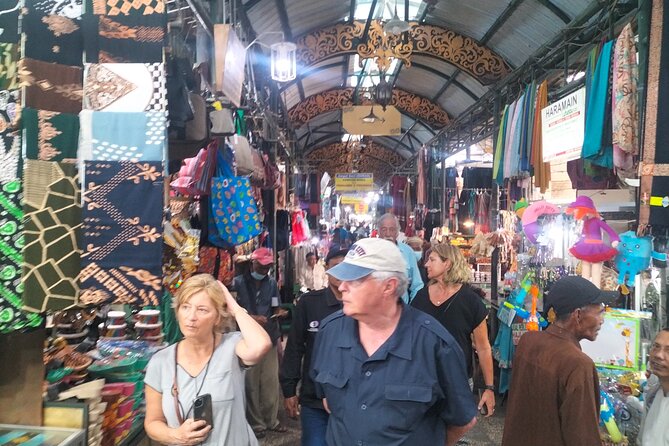
Mirota Batik receives the longest scheduled visit, one hour. It is a batik boutique and handicraft shop where you can browse batik, wooden spatulas, bags, magnets, jewelry, dream catchers, wind chimes, and other gifts.
This stop is practical if you want to buy something easy to carry home. Batik makes a more meaningful souvenir than a generic airport gift, and the wider selection gives you choices at different sizes and likely price points. Personal expenses are not included, so bring a payment method that works for your shopping needs.
The drawback is simple: an hour in a shop may feel long if you prefer streets, museums, or food. The private format helps because you can ask to shorten this stop if the earlier markets or monuments interest you more. On the other hand, if you are finishing a cruise and need gifts, the dedicated shopping time may be welcome.
Sanggar Agung Temple and the waterfront finish
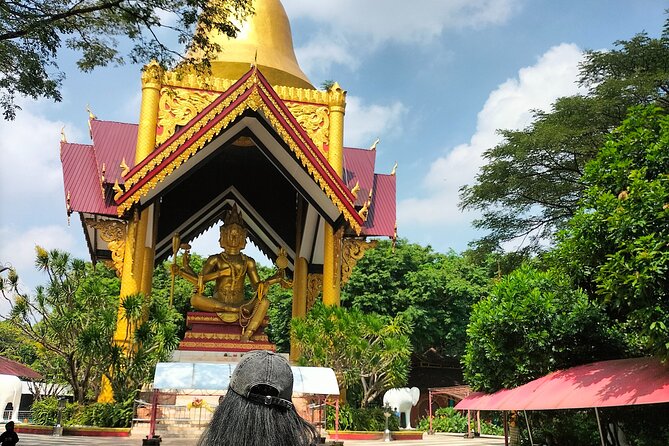
The last major stop is Kelenteng Sanggar Agung Temple, also called Sanggar Agung Temple, along with the four-faced Buddha. The visit takes about 30 minutes and returns the tour to Surabaya’s Chinese cultural side.
The temple adds a different religious setting after the mosque and Arabian market. That sequence is one of the tour’s strongest ideas: you are not just visiting separate sights, you are seeing how several communities have shaped one city. A waterfront setting also gives this stop a change of mood after the traffic and market streets.
The temple has been singled out as a beautiful part of the route, and it makes a fitting final stop because it is visually distinct. Keep your expectations measured, though. The tour allows half an hour, so you are seeing the site rather than spending a long period studying its details.
What the guides and drivers add
The strongest experiences come from the people in the car. Guides have been praised for being on time, flexible, friendly, and willing to adjust the pace. Pram was noted for recommending an itinerary that matched limited time, while Ellen handled communication before pickup and helped guests feel prepared.
Drivers matter just as much. Several accounts describe newer, clean vehicles with effective air conditioning, safe driving, and prompt transfers between stops. In Surabaya’s traffic and heat, that is not a minor comfort. It lets you step out for the walking portions without spending the whole day tired and sticky.
The personal side can also be a plus. One guide and driver were praised for talking openly with their passengers and sharing something of daily life. Zidney also took souvenir photographs and sent them through WhatsApp. These touches are not guaranteed, but they show how the private setup can feel more personal than a standard bus tour.
The weakness is consistency. Two accounts describe pleasant guides who lacked enough information about the historical sites. If detailed history is your priority, say so clearly and ask questions throughout the day. A friendly guide is helpful, but friendliness alone cannot replace strong interpretation.
Timing, comfort, and the cancellation rule
The advertised duration is four to five hours, though the listed stop times add up to roughly three and a half hours before driving is counted. Traffic, pickup location, walking speed, and shopping time will shape the actual day.
Pickup is offered from your hotel or cruise port. Private transportation, parking, fuel surcharge, bottled water, entrance fees, and facility or landing fees are included. Personal purchases and other personal expenses are not.
Free cancellation is available if you cancel at least 24 hours before the local start time. Within 24 hours, the payment is not refunded, and late changes are not accepted.
Who should book this Surabaya experience?
I would choose this tour if you have one morning in Surabaya, want a private car, and prefer a broad introduction to the city rather than one long museum visit. It suits cruise passengers particularly well because the pickup, driver, and flexible pace reduce the pressure of arranging transport independently.
It also fits couples, families, and small groups who want to move between several districts without joining strangers. The market visits suit curious eaters and photographers, while the submarine, Heroes Monument, and Balai Pemuda give the route enough history to avoid feeling like a shopping trip.
I would hesitate if you want a tightly researched history tour with long explanations at every site. In that case, confirm the guide’s language and history experience before booking, and tell the operator that interpretation matters to you.
Should you book the Private Day Tour Surabaya Historiculture?
Book it if you want to see many sides of Surabaya in half a day: naval history, colonial civic space, Chinese and Arab districts, a working fish market, Indonesian independence memory, handicrafts, and a temple. The strongest value comes from the private transport and the ability to adapt the pace, especially at $66.01 per person when shared by a small group.
Go in with realistic expectations. Some stops are short, the city can feel worn rather than polished, and the guide’s depth may vary. Ask questions, protect your preferred stops, and use the private format to shape the morning. For a first look at Surabaya, especially from a cruise port, this is a useful and well-rounded introduction.
FAQ
How long does the Private Day Tour Surabaya Historiculture last?
The tour lasts approximately four to five hours, including travel between the stops.
Where can pickup take place?
Pickup is offered from your hotel or cruise port in Surabaya.
Is this a private tour?
Yes. Only your group participates in the activity.
What is included in the price?
The price includes bottled water, private transportation, landing and facility fees, entrance fees, a private tour guide, fuel surcharge, and parking fees.
Are personal expenses included?
No. Personal expenses, including shopping and other personal purchases, are not included.
Which cultural areas does the tour visit?
The route passes through Surabaya’s Chinese quarter and explores the Arabian quarter around Sunan Ampel Mosque. The overview also refers to the European quarter.
Is the tour suitable for most people?
The supplied tour information says most people can participate. It includes both vehicle travel and walking through markets, public spaces, and cultural areas.
Does the tour include entrance fees?
Yes. Entrance fees for the listed attractions are included. The Sunan Ampel Mosque and Pabean Market are listed with no admission fee.
What is the cancellation policy?
You receive a full refund if you cancel at least 24 hours before the experience start time. Cancellations or changes made within 24 hours are not accepted and are not refunded.
Just added around Surabaya & Malang
- 1 Day – Malang Beaches and Island Hopping // 06:30 – 17:30★ 5.0 · 7 reviews
- Private Airport Transfer Surabaya★ 5.0 · 6 reviews
- Surabaya Shore Excursion For Cruise Passengers★ 4.5 · 52 reviews
- Half Day – Malang Batik Class★ 5.0 · 8 reviews
- Majapahit Heritage Archaelogy tour via surabaya★ 4.5 · 16 reviews
- Half-Day Private Majapahit Historical Tour from Surabaya★ 5.0 · 38 reviews
- Trowulan Tour Ruin of Majapahit Kingdom from Surabaya★ 5.0 · 25 reviews
- Surabaya Private Tour★ 5.0 · 86 reviews
Surabaya & Malang, compared.
Half-Day Private Majapahit Historical Tour from Surabaya
Read our review →
Trowulan Tour Ruin of Majapahit Kingdom from Surabaya
Read our review →

1 Day – Malang Beaches and Island Hopping - 06:30 – 17:30
Read our review →
Browse the lists this tour appears in