
Reviewed · WALKING TOURS
Bali Private Food Walking Tour With Locals: The 10 Tastings
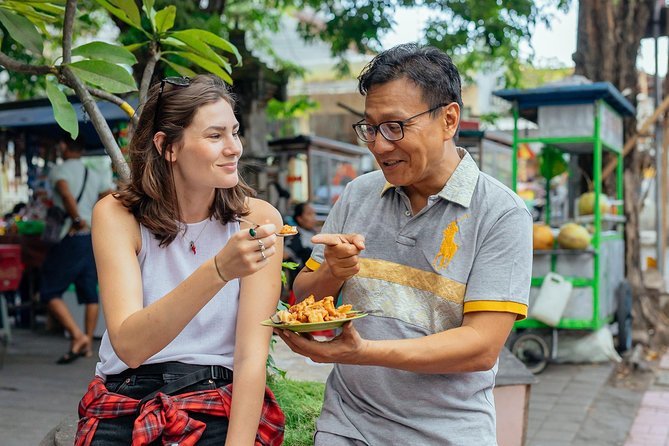
Denpasar’s best food is often found away from Bali’s resort strip, and this private tour takes you into the city’s local markets, food stalls, and small eateries. You’ll sample up to 10 Balinese foods and drinks, including babi guling, satay, fruit, snacks, and market dishes, while a local host explains what you are eating.
I like the private format, which lets you ask questions and adjust the pace. I also like the mix of food and city sights: Badung Market, the four-faced Catur Muka Statue, and an old royal palace give the meal some context. The main caution is that the experience can vary with the host, and one reported outing lasted only 90 minutes rather than the expected three hours.
Key things to know before booking
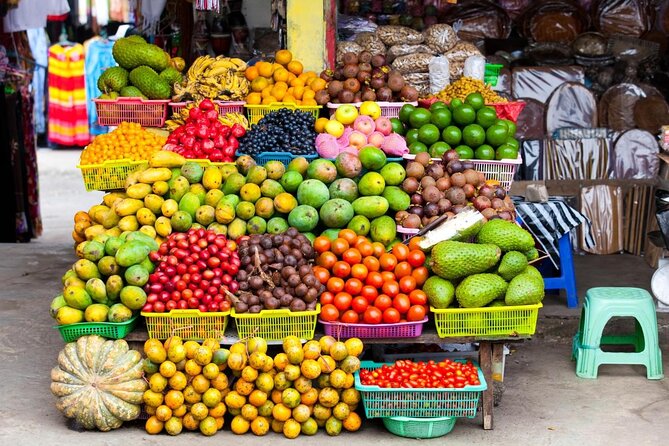
- Badung Market is the heart of the tour: This large local market gives you a look at where food and produce move through Denpasar.
- Ten tastings can equal a full meal: Come hungry, since the food may include rice dishes, pork, satay, soup, fruit, snacks, and drinks.
- You explore with only your own group: The private setup suits curious eaters who want to ask questions or request dietary changes.
- Budi, Reza, June, and Putu Merta are among the named hosts: The quality of your explanations and pacing may depend heavily on who leads your walk.
- The tour leaves the resort zone: Expect local streets and humble food stalls rather than polished restaurants aimed at tourists.
- You need moderate fitness: You will walk between stops, stand in a market, and move through busy city streets for roughly three hours.
Why Denpasar is worth eating in
Many visitors base themselves in Seminyak, but Denpasar offers a different view of Bali. It is the island’s capital and a working city, not simply a resort district. This tour uses food to help you read that city.
You begin near Pura Desa lan Puseh Desa Pekraman Denpasar on Jalan Gajah Mada. From there, your host takes you into the market area and nearby lanes. The setting can feel rougher and less arranged than a restaurant street, which is part of the point. Food may be served from modest stalls, and the market can be crowded, noisy, and unfamiliar if you have not eaten this way before.
That makes a local host useful. You are not left to guess what is safe to try, how a dish is assembled, or which foods are especially local. A good host can also help you handle unfamiliar ingredients and make sense of the produce, spices, cooking methods, and customs around the meal.
The private format is especially helpful here. You can stop to ask what a fruit is, how a sauce is made, or why one stall is preferred over another. You can also tell the host when you need a break. The tradeoff is that your experience depends more on the individual guide than it would on a large, standardized group tour.
More food tours in Bali:
- Bali Bites Food Tour with 15+ Tastings
★ 5.0 · 114 reviews - Chef Bagus Balinese Indonesian Food Cooking Class
★ 5.0 · 89 reviews - Bali Food Tour: Savor Street Food and Night Market Adventures
★ 5.0 · 46 reviews
Badung Market: the main event
The first stop is Badung Market, one of the most important produce and food markets in Denpasar. You spend about an hour here, and this is where the tour feels most rooted in everyday city life.
The market is not presented as a museum. It is a working place where local people shop and eat. You may see fresh produce, prepared foods, snacks, and ingredients used in Balinese cooking. Several descriptions of the experience point to the market’s size, with multiple levels and a wide range of food.
This is also the part that may test your comfort zone. The sights, smells, and close quarters can be a lot at first. One useful rule is to arrive with an open mind but not a blind one. Let your host choose the food and explain it, then ask questions before you try anything that concerns you.
The strongest hosts add more than names. Budi is described as patient and good at explaining ingredients and local customs. Reza is associated with unusual food stops and strong knowledge of the area. June has handled several dietary requirements and helped guests find suitable alternatives. Putu Merta is noted for explaining fruits, vegetables, and Balinese food traditions.
Those differences matter. The market itself is fixed, but the quality of your visit depends on how well your host turns a large, confusing place into a readable one. If your host introduces vendors, explains the dishes, and gives you time to look around, Badung Market can become the most memorable part of the afternoon or evening.
Ten tastings, from pork to sweet snacks
The tour promises 10 food and drink tastings chosen by your local host. The exact selection can change, so you should not treat the menu as fixed. That flexibility is useful because it allows the host to consider dietary needs and what is available that day.
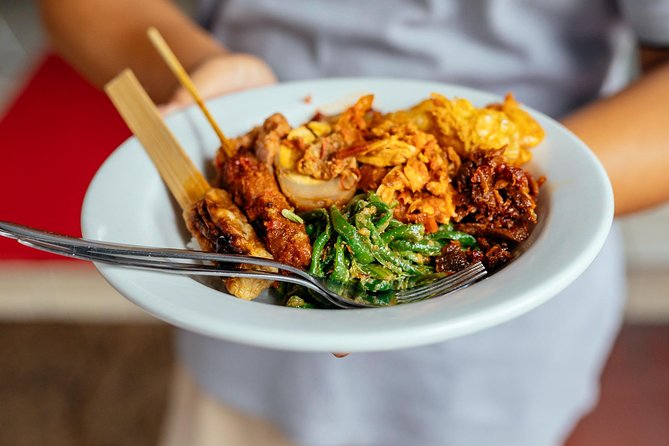
The named highlights are babi guling, Bali’s famous spit-roasted pork, and sate plecing arjuna, a local satay served with a spicy sauce. These are important dishes to try if you eat pork and meat. They give you a taste of food with a stronger local identity than the standard fried rice found on many tourist menus.
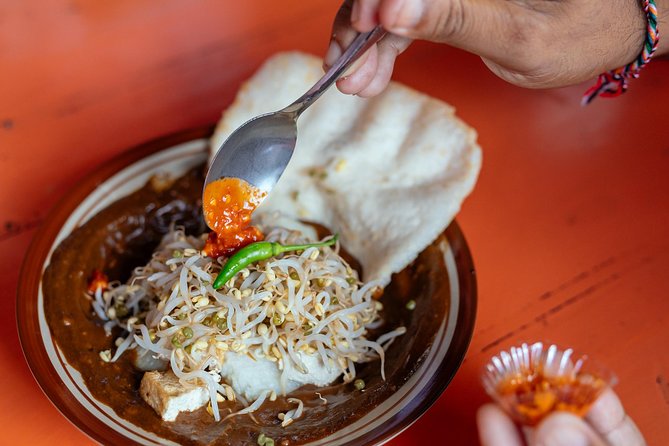
The food may go well beyond those two dishes. The tasting stops have included chicken soup, chicken with rice, crispy pork, steamed rice cake with peanut sauce, fruit, coffee, barbecue skewers, and other snacks. Some outings have included enough food to replace a full meal, and some people have had to stop before the host ran out of ideas.
That is why I would not eat a large meal beforehand. A light breakfast or snack is more sensible, especially if your tour takes place later in the day. Ten small tastings sound modest until you add rice, meat, sauces, fruit, and drinks.
The variety can also vary. One outing included no noodles, tropical fruit, or sweet treats, despite the expectation of a broad tasting experience. If those foods matter to you, tell your host early. The private format gives you a better chance of shaping the selection, but it does not guarantee every category of Balinese food.
Catur Muka Statue and the city between bites
Food is the focus, but the walking route includes short city stops. At Catur Muka Statue, you spend about 30 minutes seeing the four-faced figure from outside. Each face looks toward one of the cardinal directions, north, south, east, and west.
The statue was designed and carved by a sculptor from Ubud and built in 1973. Your host can use the stop to explain how the city is organized and how public monuments fit into local life. It is not a long sightseeing visit, but it gives you a pause from eating and a clearer sense of place.
This stop also shows the limits of the tour. You are not booking a full Denpasar sightseeing program. The statue is a short visit between food stops, and the emphasis remains on the market, stalls, and local dishes. If you want detailed architectural or religious interpretation, you may need a separate city tour.
Still, I like the inclusion. A food tour is stronger when you understand where you are eating. Seeing a central landmark helps prevent the experience from becoming a sequence of anonymous snacks.
More walking tours in Bali:
- Bali Sea Walking Experience
★ 4.5 · 82 reviews - Tetebatu Walking Tour – Rice Terraces, Waterfall & Monkey Forest
★ 5.0 · 349 reviews - Small-Group Walking and Food Tour by Night in Yogyakarta
★ 5.0 · 313 reviews - Sidemen Trekking: A Walk from a Different Perspective
★ 5.0 · 94 reviews
The royal palace stop
Another short stop takes you past a royal palace used for traditional ceremonies. The site dates to 1820 and was built by a descendant of the Klungkung royal family. You view it from outside and hear local stories rather than taking a full palace tour.
The listing refers to this stop as Kuta Puri Bungalows Spa, while the description identifies it as a royal palace. Because of that mismatch, I would treat the stop as a brief exterior look, not as a formal palace visit with guaranteed interior access.
This is a useful cultural extra, but it should not determine your booking decision. The tour’s value lies in the food and the access to local streets. The palace adds context, yet you may spend only a short time there.
What the private format changes

This is not a shared group walk. Only you and your party join the host, which gives the experience a more personal shape.
You can ask questions without holding up a large group. You can tell the host that you want more fruit, less pork, fewer spicy foods, or alternatives for dietary restrictions. The tour provider says alternatives are available, though the exact options depend on the host and the food available on the day.
The private format can also make the walking pace easier. Some people move quickly through markets, while others want time to inspect ingredients and take pictures. You can usually discuss the pace with your host, but it is still wise to explain your needs before the tour begins.
The downside is consistency. A large operator may use a more uniform route, while this experience appears to rely on local hosts with different personalities and strengths. Budi and Reza are particularly associated with strong explanations and unusual food choices. June is a good name to request if dietary restrictions are a major concern, based on her reported flexibility. Putu Merta is a useful fit if you want more discussion of produce and ingredients.
You may not be able to choose a particular host, so ask about the assigned guide when you book if that matters to you.
Is $56.78 a fair price?
At $56.78 per person, this is not the cheapest way to eat in Bali. You could buy individual street-food dishes for far less. The price pays for the host, planning, access to several stops, and the convenience of having someone guide you through a market that can feel hard to navigate alone.
The value improves if you make full use of the experience. Ask questions. Request food advice for the rest of your stay. Ask where to find a dish again, what ingredients to avoid, and how to order at a local stall. The tour specifically aims to give you practical food tips you can use after the three hours are over.
The quantity also helps. Several outings have included enough food for a full meal, and the tastings may cover dishes, snacks, drinks, fruit, and sweets. If you only want a quick introduction to babi guling, the price may feel high. If you want a guided introduction to Denpasar with substantial eating, it is more reasonable.
Group discounts may be available, and the activity uses a mobile ticket. It is commonly booked well ahead, with an average lead time of about 40 days, so I would not leave it until the last minute if the timing matters to you.
Timing, walking, and practical comfort
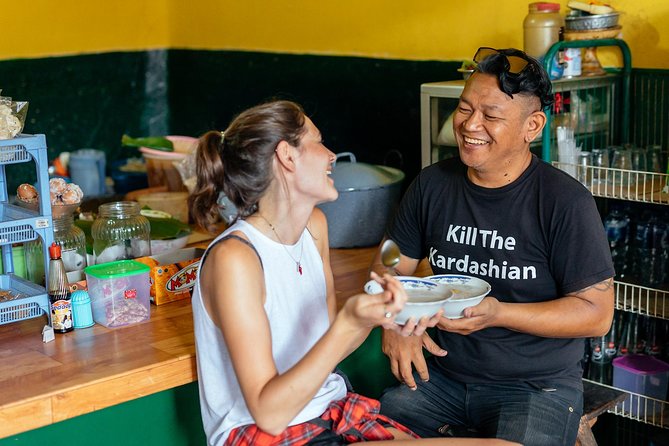
The advertised duration is about three hours, beginning and ending at the meeting point on Jalan Gajah Mada. The route includes walking between food stops, time in a market, and short sightseeing visits.
Wear comfortable shoes and arrive ready to walk. You should have a moderate level of fitness, not because this is a strenuous hike, but because standing, moving through market lanes, and walking between stops can add up. One particularly negative experience lasted only 90 minutes, so it is worth confirming the start time and expected duration with your host at the beginning.
The tour is near public transportation, but transport to the meeting point is not described as included. Plan that part separately. The activity ends where it begins, so you can arrange your next meal, shopping stop, or ride from the same general area.
Food safety is a personal concern for many people at markets. The tour gives you a local host to help select the food, and some food is prepared in front of you. Still, you should tell the host about allergies and restrictions before eating. Dietary alternatives are offered, but you should not assume every dish can be adapted.
Who should book this experience?
I would choose this tour for a first visit to Bali if you want food to lead the way. It is particularly suited to people staying in Seminyak or nearby who want to see a less resort-focused side of the island without arranging a full day trip.
It also works well for families and small groups. The private format makes it easier to manage different appetites, and children can try small portions rather than committing to a full unfamiliar meal. The food volume may be too much for picky eaters, so discuss the menu before setting out.
Food lovers who enjoy local markets will get the most from it. You should be comfortable with simple stalls, new textures, strong flavors, and a setting that may not be polished. If you prefer air-conditioned restaurants, fixed menus, and a clear schedule, this may feel too loose.
I would also recommend it early in your Bali visit. The best advice is often practical: where to eat, what to order, and which local dishes deserve another try. The food tips can shape the rest of your stay.
Should you book it?
Book this private Denpasar food walk if you want a substantial meal, local market access, and a guide who can help you make sense of unfamiliar Balinese dishes. The strongest version includes a generous range of food, useful cultural context, and a host such as Budi, Reza, June, or Putu Merta who takes time to explain what is happening.
Go in with realistic expectations. This is not a polished restaurant crawl or a full sightseeing tour. The market may feel intense, the palace stop is brief, the exact 10 tastings can change, and the host’s performance matters a great deal.
Before you commit, state your dietary needs, ask how long the tour is expected to last, and confirm what sort of host will lead it. If you are hungry, curious, and willing to eat where local people eat, the $56.78 price can be fair value for an introduction to Denpasar’s food culture.
FAQ
Where does the tour begin?
It begins at Pura Desa lan Puseh Desa Pekraman Denpasar on Jalan Gajah Mada in Denpasar.
Where does the tour end?
The activity ends back at the meeting point.
How long does the food tour last?
It is scheduled to last approximately three hours.
Is this a private tour?
Yes. Only you and your group participate with the local guide.
How many tastings are included?
The tour includes 10 food and drink tastings.
Which Balinese dishes may be included?
Named dishes include babi guling and sate plecing arjuna. Other tastings may include snacks, fruit, drinks, and local dishes selected by the host.
Are dietary alternatives available?
Yes. Alternatives are offered for dietary restrictions, and you should share those needs when booking or with the host before the tour begins.
Do I need to be physically fit?
You should have a moderate level of physical fitness because the experience includes walking between food stops and time spent in the market.
Can I cancel for a refund?
You can cancel at least 24 hours before the start time for a full refund. Cancellations or changes made within 24 hours are not refunded or accepted.
Just added around Bali
- Bali Parasailing Adventure, Jet Ski, Banana Boat , Donat Boat, with Transport★ 5.0 · 11 reviews
- 1.5 Hours Bali ATV Quad Tour★ 5.0 · 8 reviews
- ATV Quad Bike Through Tunnel and Waterfall★ 5.0 · 3 reviews
- Bali Driver Recommendation★ 5.0 · 7 reviews
- Bali Private Custom Tour★ 5.0 · 12 reviews
- Bali Cooking Class Experience with All Inclusive★ 5.0 · 12 reviews
- Penglipuran Village Waterfall Swing Private Guided Tour★ 5.0 · 13 reviews
- Bali Sightseeing Car Hire with English-speaking Guide and Driver★ 5.0 · 24 reviews
Walking Tours, compared.

Tetebatu Walking Tour – Rice Terraces, Waterfall & Monkey Forest
Read our review →
Small-Group Walking and Food Tour by Night in Yogyakarta
Read our review →
Sidemen Trekking: A Walk from a Different Perspective
Read our review →
Ubud yoga, rice terrace walk and floating Breakfast tour
Read our review →

Ubud Countryside Tour: Campuhan Ridge Walk and Rice Terrace
Read our review →
Private Tour: Campuhan Ridge Walk, Ubud Rice Terrace & Ubud Palace
Read our review →Browse the lists this tour appears in